Dear Young Scholar,
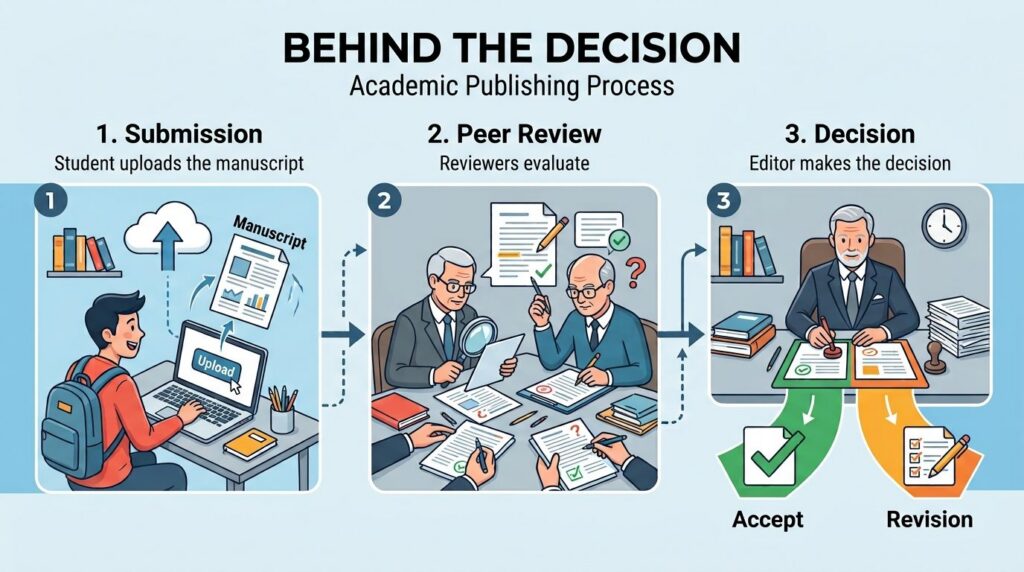
You have completed your research, organized your data, and submitted your manuscript to emergingpapers.com. Congratulations! You have taken a monumental step in your academic journey. But what actually happens on the other side of the screen once you click that “Submit” button?
The Editorial Desk is not a courtroom designed to judge your work; it is an editorial guide aimed at elevating your research to international publishing standards. Understanding this process will ease your anxiety and help you navigate review stages smoothly.
- How to Read Revision Decisions (Major and Minor Revision)
Receiving a revision request from the Editor should never discourage you. In academic publishing, a revision request is not a rejection; it is a clear signal that your paper has strong potential.
- Minor Revision: Indicates small technical, linguistic, or formatting adjustments. You might be asked to clarify a graph, fix citation styles, or correct typos. Complete these requests promptly and resubmit your manuscript.
- Major Revision: Means your methodology, data analysis, or discussion section requires deeper explanation. Address the reviewers’ and editor’s feedback point-by-point, and resubmit your revised paper alongside a brief “Response to Editor” letter outlining the changes you made.
- What Should You Do If You Receive a Rejection?
A rejection decision does not mean your research or ideas are without value. Even the most distinguished university professors receive dozens of rejections throughout their careers. Your manuscript may simply fall outside our scope, require a broader dataset, or need stronger structural framing.
Read the editorial feedback carefully, use the critiques to refine your draft, and build a stronger foundation for your future academic projects.
- Should You Email the Editor to Ask “What’s the Status of My Paper?”
Avoid sending frequent inquiry emails asking “What is the status of my paper?” shortly after submission. The editorial and peer-review processes require dedicated time and thorough attention. Checking your submission dashboard is sufficient. Unless the standard review timeline (typically 2–4 weeks) has passed, there is no need to email the editor for status updates.
- Post-Acceptance Process: From Editor to Editor-in-Chief
Once your manuscript receives an official acceptance, the primary editorial evaluation ends, and your paper moves to the final publishing stage:
- Production & Layout: Your manuscript is formatted into our official journal layout.
- Proofreading: You will receive a final proof version to check your name, school affiliation, and data formatting one last time.
- Billing & Administrative Processing: Necessary processing and invoice steps are finalized.
- Issue Inclusion: The Editor-in-Chief assigns your finalized paper to the current continuous volume or scheduled issue, making your work officially accessible to the global scientific community.
Remember, our editorial team is not here to set up barriers, but to help you present your research to the world in its finest form.